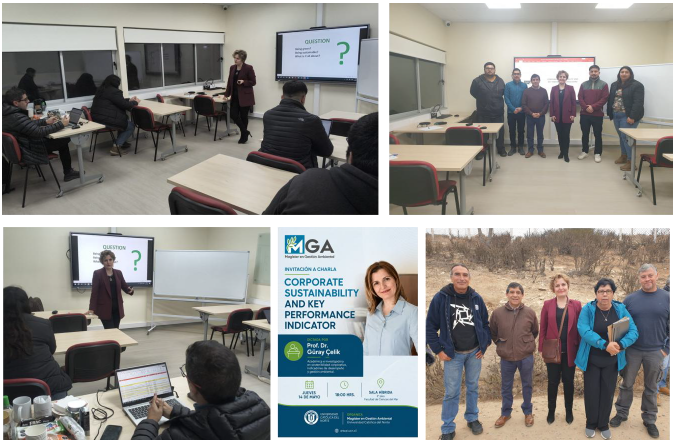
As part of the TÜBİTAK 124N067 project titled “Sustainable Management of Aquaculture Production Systems” , a presentation titled “Corporate Sustainability and Key Performance Indicator” was delivered on 14 May 2026 to the students of the Magíster en Gestión Ambiental program at Universidad Católica del Norte. This training activity, included in the program under the title “Indicators of Environmental Sustainability and Management Systems,” emphasized that the corporate sustainability approach is not limited solely to the monitoring of environmental performance; rather, institutions need to strengthen their sustainability capacities through strategic management, risk and opportunity analysis, resource efficiency, environmental management systems, and measurable performance indicators. The presentation particularly addressed the role of key performance indicators in corporate decision-making processes, the monitoring of sustainability targets, the measurement of environmental impacts, and their integration with management systems. In this way, it was shared with the students that corporate sustainability is a practical, measurable, and manageable field of transformation.
In addition, the presentation titled “Aquaculture and Sustainable Development: Ending Hunger through Responsible Food Production” was delivered. The discussions held with university faculty members and students, together with the field observations, revealed the strategic position of aquaculture within global food security debates. In the presentation, it was stated that the world population is expected to reach 9.7 billion by 2050 and that the demand for animal protein may increase by 88% by 2050. In this context, blue foods are considered not only as an alternative protein source, but also as an important component of sustainable food systems due to their low environmental footprint, high nutritional value, and climate-friendly production potential.
The presentation stated that blue foods include fish, crustaceans, molluscs, algae, aquatic plants, and other aquatic organisms, and that these foods can be obtained from inland water, coastal, and marine ecosystems. It was also emphasized that aquaculture offers important advantages in terms of diversity, nutritional value, and environmental performance; however, its sustainability performance may vary depending on production systems, species, feed use, energy consumption, and local ecosystem conditions.
Our sincere thanks to Prof. Dr. Güray Çelik for the valuable presentation and to all participants for their active engagement.