
General Information
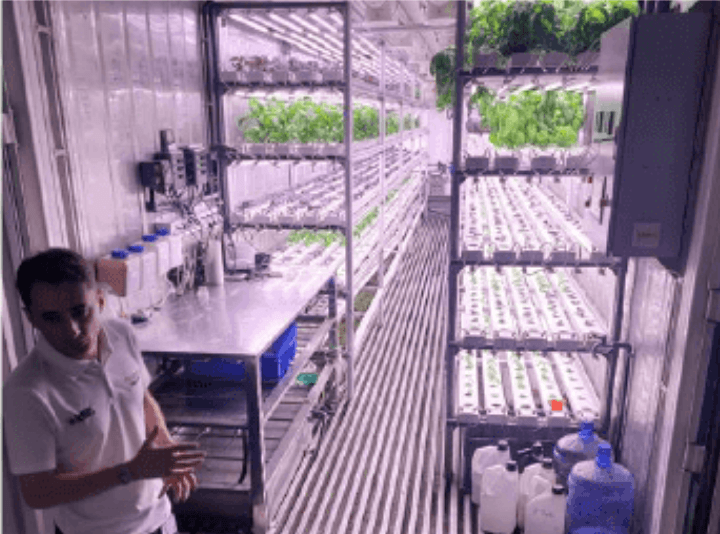
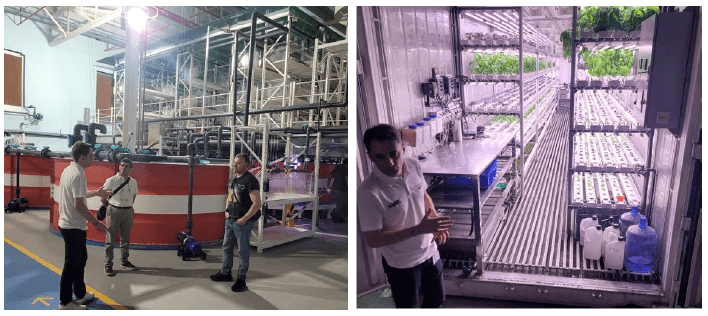
This aquaponics facility located in Bursa stands out as one of the most advanced aquaculture investments in Turkey. The facility aims to integrate recirculating aquaculture systems (RAS) with aquaponics technologies, enabling the management of aquaculture and plant production within the same ecosystem. Due to its strategic importance, detailed information is shared only through authorized reports. The facility is intended to become a pioneering center that enhances Turkey’s R&D capacity in water and food security. Figure 1 presents images of the facility. As the site can only be visited with special permission and has not yet been officially opened, confidentiality is emphasized.
Water Source
Unlike conventional systems that rely on natural spring water, the facility is designed based on a closed-loop water management approach. With RAS technology, 99% of the water is recirculated, and only losses due to evaporation and maintenance are replenished. This approach enhances sustainability, particularly in regions with limited water resources. Water quality is continuously monitored by sensors, and parameters such as pH, dissolved oxygen, temperature, and ammonia are automatically controlled. This model is currently implemented in only a limited number of facilities in Turkey.
Production Stages and Equipment
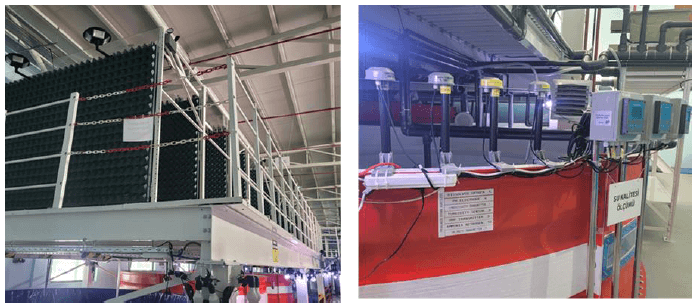
The production process is based on high-tech fish tanks (with shrimp cultivation also being considered) integrated with biofiltration and hydroponic plant production systems. Feeding of fish (or shrimp) is carried out by automated units, while water purification is ensured through mechanical filtration, biofiltration, ozone treatment, and UV disinfection. Plant production units utilize fish waste as a nutrient source, thereby completing the closed-loop system. This infrastructure enhances efficiency and results in a significantly smaller environmental footprint compared to conventional systems. Figure 2 presents images of the equipment and systems used in the facility. In particular, continuous parameter monitoring and the concept of species-specific volume optimization are emphasized.
Water Quality and Analyses
Thanks to continuous monitoring systems, the facility tracks water quality in real time. Parameters such as dissolved oxygen, pH, temperature, ammonia, and nitrate are measured using automated sensors, and the data are recorded digitally. This approach prevents sudden fluctuations in water quality and ensures optimal fish welfare. In addition, chemical and microbiological analyses are regularly verified by external accredited laboratories. This system demonstrates that the applied technology is comparable to that of modern RAS facilities in Europe.
Chemical Use
One of the key features of the facility is the minimization of chemical use. Disease prevention strategies are based on biosecurity measures and biofiltration. Ozone and UV systems are used for water disinfection, while antibiotics are used only in exceptional cases. This approach is important for both food safety and environmental sustainability. The aim is to adopt a production policy compliant with the international standards of the Aquaculture Stewardship Council (ASC).
Suppliers
The facility collaborates with both international and local suppliers. High-quality fish feed is sourced from European producers, while a significant portion of the hydroponic and RAS equipment is developed in Turkey. This approach aims to enhance local production capacity through technology transfer. Additionally, partnerships are established with domestic engineering firms to support renewable energy solutions. The supply chain is structured with a focus on sustainability and the reduction of external dependency.
Waste and Waste Management
The facility is designed with a zero-waste approach. Fish feces and uneaten feed are separated through mechanical filtration and utilized as nutrients in hydroponic plant production systems. The sludge fraction is concentrated using decanter centrifuges and converted into organic fertilizer. In this way, both solid and liquid wastes are valorized, with the aim of achieving zero discharge to the environment. These practices are aligned with the FAO’s principle of “using waste as a resource.”
Cost Items
The facility is a capital-intensive project. The major cost components include advanced automation systems, biofiltration and disinfection units, energy consumption, and international technology transfer. However, in the long term, savings in water and feed usage, the reduction of environmental costs, and the production of high-value-added products are expected to generate a strong return on investment. Based on similar facilities in Europe, a payback period of 5–7 years is considered feasible.
Challenges
The main challenges include high initial investment costs and higher energy consumption during operation compared to conventional systems. There is also a need for qualified personnel, particularly experts in bioengineering and environmental engineering. Since RAS-based production is still limited in Turkey, local know-how remains under development. For this reason, joint R&D activities with universities are being conducted within the scope of the project to enhance technical capacity.
Innovation
This facility is one of the first large-scale aquaponics R&D centers in Turkey established based on a “zero-water” concept. The system, which integrates aquaculture and plant production within a single cycle, offers an innovative model in terms of energy and resource efficiency. In addition, industrial symbiosis practices such as biogas production and organic fertilizer development are utilized. This structure presents a vision aligned with both the FAO and the EU’s 2030 Green Transition goals.
Employees
Unlike traditional farms, the facility’s staff structure is based on a highly skilled workforce. An interdisciplinary team consisting of agricultural engineers, biologists, environmental engineers, food engineers, and technical operators is planned. Most of the personnel will be engaged in research and development activities. Thus, the facility will function not only as a production site but also as a training and innovation center. Local employment is also prioritized, and it aims to attract young people from the local community to this field through technical training.
Recommendations
To ensure the facility’s sustainability, renewable energy sources should be integrated into the system. Solar panels and biogas production units are expected to reduce energy costs. In addition, rapid entry into international accreditation schemes (e.g., ASC, GlobalG.A.P.) will strengthen the facility’s export capacity. University–industry collaboration should be further enhanced, particularly by supporting R&D projects on water quality optimization and feed efficiency. Finally, the scientific outputs obtained should be disseminated through authorized reports, and Turkey’s leadership potential in aquaponics should be promoted on international platforms. Table 1 presents a summary of the facility.
Table 1. General Information on the Facility
|
GENERAL |
|
| Facility Area | Under construction in the Orhangazi–İznik region. |
| Water Source | The system is designed for closed-loop water management. With RAS technology, 99% of the water is recirculated, and only evaporation and maintenance losses are replenished. |
| Water Quality Characteristics | The facility monitors water quality in real time thanks to continuous monitoring systems. In addition, chemical and microbiological analyses are regularly verified at external accredited laboratories. |
|
ECONOMY |
|
| Income/ Expenses | The largest cost items include advanced technology equipment and international technology transfer. However, in the long term, savings in water and feed use, reduction of environmental costs, and high-value-added products are expected to yield a strong return on investment. Based on similar facilities in Europe, a payback period of 5–7 years is possible. |
| Suppliers | The facility works with both international and local suppliers. |
|
SOCIAL |
|
| Work Areas | The staff structure is based on a highly skilled team unlike traditional farms. An interdisciplinary group of agricultural engineers, biologists, environmental engineers, food engineers, and technical operators is planned. Most personnel will focus on R&D activities. Thus, the facility will be not only a production site but also a training and innovation center. Local employment is also valued, aiming to attract local youth to the field through technical training. |
|
ENVIRONMENT |
|
| Energy Use Areas: | Units and equipment used in the system |
| Energy Produced | – |
| Generated Waste | The facility is designed with a zero-waste vision. |
|
INNOVATION |
|
| Implemented Practices | The system, which combines aquaculture and plant production in a single cycle, offers an innovative model in terms of energy and resource efficiency. In addition, industrial symbiosis approaches such as biogas production and organic fertilizer development are utilized. |